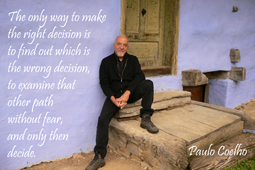
I've been questioning this for a long time. I think this statement can depend on the situation. There are some things which are clear-cut in my mind, as to what 'right' and 'wrong' is. But then there are other things that cannot be learned by reading or knowing, but only through experience. In that case, I think Mr. Coelho is right.
What are your thoughts?



I think it's a gross oversimplification to say there are right and wrong decisions, and even more difficult to determine which is which. In hindsight, it is widely said that the decision to let Lehman fail was the "wrong" decision. We are currently examining that path with a lot of fear, and there isn't really a way to renege on the previous choice.
ReplyDeleteI more or less agree with CC. I could never offer that statement as advice to anyone. It doesn't even make any sense to me. You could guess and sometimes arrive at a "right decision," so there's more than one way to do that, and if you already know what the "wrong decisions" are, there's no examining necessary, because that leaves the right decision.
ReplyDeletePerhaps Mr. Coelho is in fact trying to say something about foresight, understanding the consequences of an action, or the value of experience, but it that's the case then something may have been lost in translation.
Ditto the above. "Right" and "wrong" are both relative terms and have no absolute value. A decision is simply that: a decision. It's not so much the things you choose to do, but what you make of them. For example, consider a decision you think was the right one. If you'd done the opposite thing, the "wrong" decision, you'd simply have become a different person, not a "wrong" person. I think you can be pleased with a decision but I don't think it has any inherent positive or negative qualities.
ReplyDelete-sharona
To Sharona:
ReplyDeleteI think there are times when an absolute right and an absolute wrong do exist. (Of course, absolutism, in this sense, is limited by human perception.)
Consider the following question:
What is the capital of Germany?
Certainly the individual who answered Hamburg is not as correct as the one who answered Berlin? In fact, isn’t one exactly correct and the other exactly incorrect? (I know this a pedantic counterexample, but I am really unimaginative when comes to providing counterexamples, I probably come with something better later.)
Secondly, does Coelho intend right and wrong to be construed absolutes? I think he means for us to gauge what is right and wrong ourselves. For example, in a moral sense that may mean we should follow our principles by dismissing whatever decision contradicts them.
To the Penguin Scribbler:
In order apply his method, do we not need a priori knowledge of the right and wrong decisions. What if the only way to find the wrong choice was through experimentation and observation? Since we often don’t know which choice is wrong in advance, the entire statement seems useless.
I guess, Coelho could say, "the only way to make the right decision is to find out which is the wrong decision [when it is knowable beforehand], to example that other path without fear, and then only decide.", but that sentiment is decidedly un-charming and points to glaring weakness in the practicality of his statement.
All in all, I find Mr. Coelho seems far more interested in finding his “textbyte” on a motivation poster, then in providing some useful thoughts on decision making.
Even if one answer is "correct" in that case, I don't think that proves a concept of absolute right or absolute wrong. "Absolute" generally means a truth or concept that exists universally and beyond things like human society and human knowledge. Things like countries and capitals are arbitrary human creations. Outside of our society and outside of the human race, "the capital of Germany" has no actual meaning. So, while one answer might be the one you're looking for in order to conform to a rule humans have set down, that doesn't make it an absolute.
ReplyDeleteThe other important point is that an absolute cannot change over time: it is universal and fixed. We (as a whole, of course, not just one or two people) can decide to change the capital of Germany, but if there were actually a concept like absolute moral correctness, existing beyond human-created rules, it could not change.
-sharona